44 pytorch dataloader without labels
python - Adding custom labels to pytorch dataloader/dataset ... Jun 28, 2019 · As others mentioned you have to implement a custom dataset as it is important to make __getitem__ return the sample and its label. Otherwise the DataLoader can not figure out the labels by itself. I also recommend PyTorch documentation about Creating a Custom Dataset for your files and this YouTube video. Load Pandas Dataframe using Dataset and DataLoader in PyTorch. Then, the file output is separated into features and labels accordingly. Finally, we convert our dataset into torch tensors. Create DataLoader. To train a deep learning model, we need to create a DataLoader from the dataset. DataLoaders offer multi-worker, multi-processing capabilities without requiring us to right codes for that.
Create a pyTorch testing Dataset (without labels) - Stack Overflow This works well for my training data, but I get an error ( KeyError: " ['label'] not found in axis") when loading the testing csv file, which is identical other than there being no "label" column. If it helps, the intended input csv file is MNIST data in csv file which has 28*28 feature columns.

Pytorch dataloader without labels
DataLoader returns labels that do not exist in the DataSet - PyTorch Forums Jun 10, 2020 · transform (torch transforms): if None is skipped, otherwise torch applies transforms """ self.h5_path = h5_path self.train = train self.train_idx = None self.train_cutoff = 0 self.labels = None # this isn't too intensive self.transform = transform # load the data file into memory self.data = h5py.File(self.h5_path, "r") self.labels = np.array(self.data["labels"]) # get labels for the train/test split, first 91 cat for train self.train_idx = np.argmax(self.labels > 90) if self.train: self ... Datasets & DataLoaders — PyTorch Tutorials 1.12.0+cu102 documentation Dataset stores the samples and their corresponding labels, and DataLoader wraps an iterable around the Dataset to enable easy access to the samples. PyTorch domain libraries provide a number of pre-loaded datasets (such as FashionMNIST) that subclass torch.utils.data.Dataset and implement functions specific to the particular data. They can be used to prototype and benchmark your model. 39 pytorch dataloader without labels - Blogger.com Data loader without labels? - PyTorch Forums Is there a way to the DataLoader machinery with unlabeled data? PyTorch Forums. Data loader without labels? cossio ...
Pytorch dataloader without labels. Loading an HDF5 dataset with DataLoader - data - PyTorch Forums Loading an HDF5 dataset with DataLoader. I have two HDF5 datasets that has cat images and non cat images (64x64x3 [x209 train, x50 test]) for training and testing. Each with a list of classes (0 for non cat, 1 for cat), a train_set_x → the images, and a train_set_y → the labels for the images. I know I need to make a custom dataset with ... Creating a custom Dataset and Dataloader in Pytorch - Medium A dataloader in simple terms is a function that iterates through all our available data and returns it in the form of batches. For example if we have a dataset of 100 images, and we decide to batch... Issue with DataLoader with lr_finder.range_test #71 - GitHub Because inputs_labels_from_batch() was designed to avoid users modifying their existing code of dataset/data loader. You can just implement your logic inside it. And just note that you have to make sure the returned value of inputs_labels_from_batch() have to be 2 array-like objects, just like the line 41 shows: anndata DataLoader for pyTorch without DistributedSampler #757 When I try to predict a cell type label using the predict function, pyTorch lightning wants to use the DistributedSampler as sampler, which is not implemented in the AnnLoader and I could not figure out how to disable the sampler. Here's my code: import gdown import pytorch_lightning as pl import torch import torch.nn as nn import numpy as np
Data loader without labels? - PyTorch Forums Jan 19, 2020 · Yes, DataLoader doesn’t have any conditions on the number of outputs of your Dataset as seen here: class MyDataset (Dataset): def __init__ (self): self.data = torch.randn (100, 1) def __getitem__ (self, index): x = self.data [index] return x def __len__ (self): return len (self.data) dataset = MyDataset () loader = DataLoader ( dataset, batch ... Iterating through DataLoader using iter() and next() in PyTorch Our DataLoader would process the data, and return 8 batches of 4 images each. The Dataset class is an abstract class representing the dataset. It allows us to treat the dataset as an object of a class, rather than a set of data and labels. Dataset class returns a pair of [input, label] every time it is called. python - Training a CNN model with DataLoader on a GPU in PyTorch ... Training a CNN model with DataLoader on a GPU in PyTorch. I am trying to classify chest x-rays into two categories: 'normal', and 'pneumonia'. My training and test sets are DataLoader objects with num_workers=0, pin_memory=True. Cuda is available on my device (GTX 1060 6GB). After creating the CNN I call model = CNN ().cuda (). Beginner's Guide to Loading Image Data with PyTorch Create a DataLoader The following steps are pretty standard: first we create a transformed_dataset using the vaporwaveDataset class, then we pass the dataset to the DataLoader function, along with a few other parameters (you can copy paste these) to get the train_dl. batch_size = 64 transformed_dataset = vaporwaveDataset (ims=X_train)
How to use Datasets and DataLoader in PyTorch for custom text data TD = CustomTextDataset (text_labels_df ['Text'], text_labels_df ['Labels']): This initialises the class we made earlier with the 'Text' and 'Labels' data being passed in. This data will become 'self.text' and 'self.labels' within the class. The Dataset is saved under the variable named TD. The Dataset is now initialised and ready to be used! Custom Dataset and Dataloader in PyTorch - DebuggerCafe testloader = DataLoader(test_data, batch_size=128, shuffle=True) In the __init__ () function we initialize the images, labels, and transforms. Note that by default the labels and transforms parameters are None. We will pass them as arguments depending on our requirements for the project. PyTorch Dataloader + Examples - Python Guides In this section, we will learn about How PyTorch dataloader can add dimensions in python. The dataloader in PyTorch seems to add some additional dimensions after the batch dimension. Code: In the following code, we will import the torch module from which we can add a dimension. Load custom image datasets into PyTorch DataLoader without using ... Iterate DataLoader We have loaded that dataset into the DataLoader and can iterate through the dataset as needed. Each iteration below returns a batch of train_features and train_labels. It containing batch_size=32 features and labels respectively. We specified shuffle=True, after we iterate over all batches the data is shuffled.
ValueError: only one element tensors can be converted to Python scalars - PyTorch Forums
PyTorch: Train without dataloader (loop trough dataframe instead) Create price matrix from tidy data without for loop. 20. Loading own train data and labels in dataloader using pytorch? 0. Can pytorch / keras support dataloader object of Image and Text? 3. Python: Fast indexing of strings in nested list without loop. 1. pytorch __init__() got an unexpected keyword argument 'train' 0.

Limiting the Size of a PyTorch Dataset / DataLoader | James D. McCaffrey
Loading Image using PyTorch - Medium 3. Data Loaders. After loaded ImageFolder, we have to pass it to DataLoader.It takes a data set and returns batches of images and corresponding labels. Here we can set batch_size and shuffle (True ...

【PyTorch】2.1 DataLoader与Dataset_尊新必威的博客-CSDN博客
Loading data in PyTorch — PyTorch Tutorials 1.12.0+cu102 documentation The DataLoader combines the dataset and a sampler, returning an iterable over the dataset. data_loader = torch.utils.data.DataLoader(yesno_data, batch_size=1, shuffle=True) 4. Iterate over the data. Our data is now iterable using the data_loader. This will be necessary when we begin training our model!

How To: Create a Streaming Data Loader for PyTorch | James D. McCaffrey
Training a Classifier — PyTorch Tutorials 1.12.0+cu102 documentation Training an image classifier. We will do the following steps in order: Load and normalize the CIFAR10 training and test datasets using torchvision. Define a Convolutional Neural Network. Define a loss function. Train the network on the training data. Test the network on the test data. 1. Load and normalize CIFAR10.

Fashion MNIST classification using custom PyTorch Convolution Neural Network (CNN) - John Bosco
How do I predict a batch of images without labels - Part 1 (2019) 7 Dec 2018 — I have a trained saved model, and I can't see a way to predict the label for a large batch of images without somehow faking a databunch that ...

#008 PyTorch - DataLoaders with PyTorch | Master Data Science
[Pytorch]PyTorch Dataloader custom data reading (all pictures in one ... [Pytorch]PyTorch Dataloader custom data reading. Sort out the user-defined data reading methods you see. There are three better articles. In fact, the user-defined method is to return the train and test of the existing data set with the list containing image path and label respectively, so you need to adapt according to the data set.

Pytorch-DataLoader 和 Dataset-拜师资源博客
Loading own train data and labels in dataloader using pytorch? # create a dataset like the one you describe from sklearn.datasets import make_classification x,y = make_classification () # load necessary pytorch packages from torch.utils.data import dataloader, tensordataset from torch import tensor # create dataset from several tensors with matching first dimension # samples will be drawn from the first …

How to build custom dataloader for your own dataset in PyTorch This article will simplify data ...
Custom Dataloader in pytorch - Data Science Stack Exchange I am working on an image classification project where I have some images in a folder and their corresponding labels in a CSV file. The indices are randomly arranged in the dataframe where the index maps to the list of indices of images in the directory.

Limiting the Size of a PyTorch Dataset / DataLoader | James D. McCaffrey
Image Data Loaders in PyTorch - PyImageSearch A PyTorch Dataset provides functionalities to load and store our data samples with the corresponding labels. In addition to this, PyTorch also has an in-built ... A PyTorch DataLoader accepts a ... able to access all of Adrian's tutorials in a single indexed page and being able to start playing around with the code without going through ...

How to Build a Streaming DataLoader with PyTorch | by David MacLeod | Speechmatics | Medium
Creating a dataloader without target values - PyTorch Forums I am trying to create a dataloader that will return batches of input data that doesn't have target data. Here's what I am doing: torch_input = torch.from_numpy (x_train) torch_target = torch.from_numpy (y_train) ds_x = torch.utils.data.TensorDataset (torch_input) ds_y = torch.utils.data.TensorDataset (torch_target) train_loader = torch ...
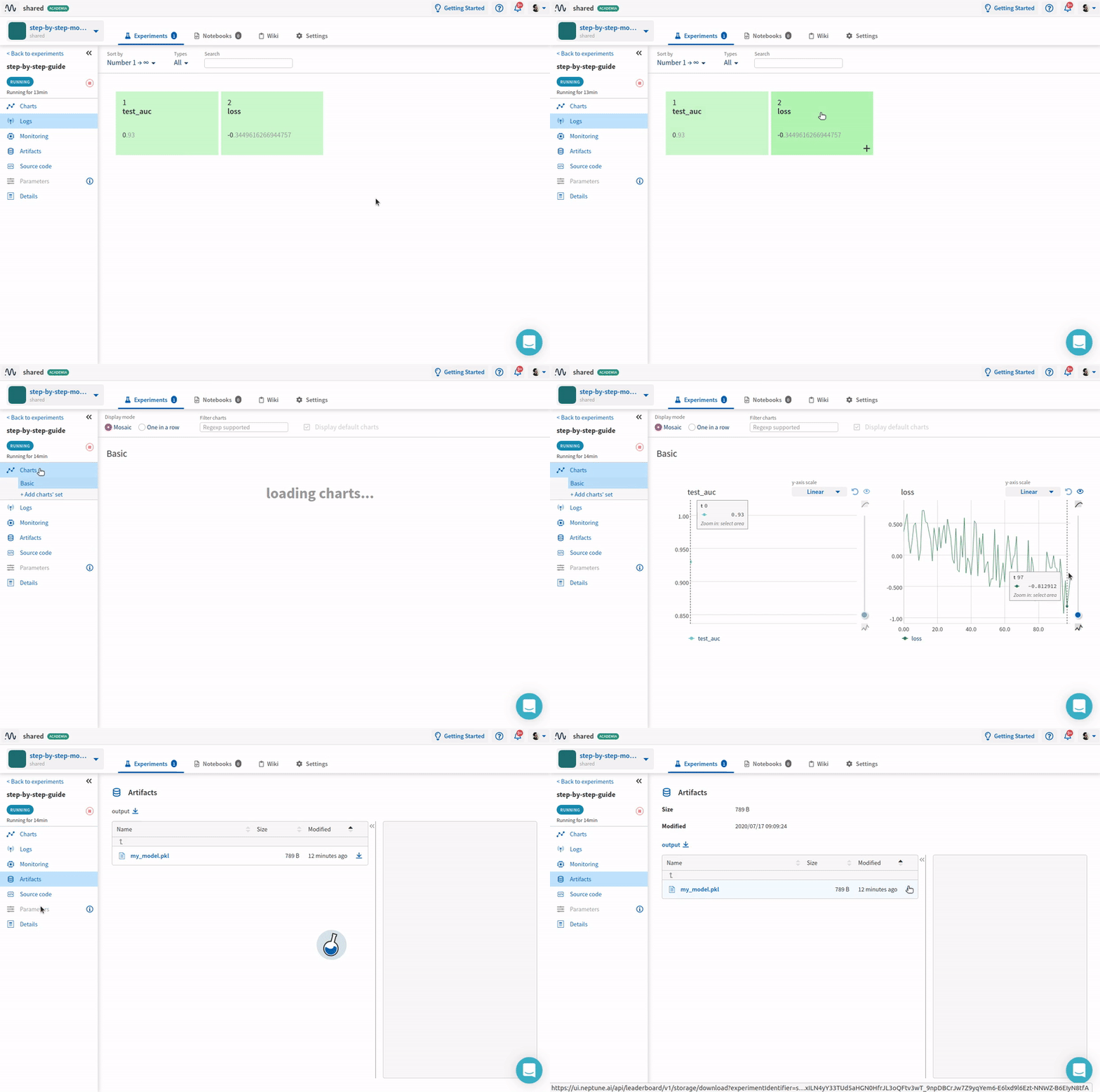
A Complete Guide to Monitoring ML Experiments Live in Neptune - neptune.ai
A detailed example of data loaders with PyTorch pytorch data loader large dataset parallel ... A good way to keep track of samples and their labels is to adopt the following framework:.
Post a Comment for "44 pytorch dataloader without labels"