44 periodic table with metal and nonmetal labels
Periodic Table of Elements - PubChem Such was the case when IUPAC recently reviewed elements 113, 115, 117 and 118, and decided to give them official names and symbols (goodbye, ununseptium and hello, tennessine!). Atomic weights found within a periodic table one might think are constant. The truth is that atomic weights have changed as a function of time. Periodic Table of the Elements - Metals Periodic Table of Elements Metals The elements are divided into two main types, metals and nonmetals, based on their properties. About 75% of the elements are classified as metals. The name metal comes from the Greek word "m tallon" meaning "mine, quarry, metal". Properties of metals: Mostly solids Hard, shiny, malleable meaning flexible
Metallic & nonmetallic property , Acidic & basic property in the ... They react with alkalis forming salt and water.. CO 2 ( g ) + 2NaOH ( aq ) → Na 2 CO 3 ( aq ) + H 2 O ( l ). From the acidic oxides , Carbon dioxide CO 2, Sulphur trioxide SO 3, Nitrogen dioxide NO 2 .. Basic oxides. The metallic oxides are usually known as basic oxides , Some basic oxides are not soluble in water and others are soluble in water forming alkalis , the water soluble basic ...

Periodic table with metal and nonmetal labels
Metals and non-metals in the periodic table - The periodic table - AQA ... Metals are on the left of the periodic table, and non-metals are on the right. Atomic structure and the periodic table Elements in group 1 and group 2 are metals. Atoms of group 1 elements have one... Groups and Periods of the Periodic Table --------------------Metals ... Metals (left side of a period) generally have a lower electron affinity than nonmetals (right side of a period), with the exception of the noble gases. According to their shared physical and chemical properties, the elements can be classified into the major categories of metals, metalloids and nonmetals. Metals Most elements are metals. Metals, Nonmetals, and Metalloids of the Periodic Table Elements of the periodic table are grouped as metals, metalloids or semimetals, and nonmetals. The metalloids separate the metals and nonmetals on a periodic table. Also, many periodic tables have a stair-step line on the table identifying the element groups. The line begins at boron (B) and extends down to polonium (Po).
Periodic table with metal and nonmetal labels. Labeled Periodic Table of Elements with Name [PDF & PNG] There are 18 groups in the periodic table, which consists of metal and nonmetal. Protons in the tables are positively charged particles. Neutrons are the neutrally negative charge, and electrons are the negative charge particles. It also shows the formation of a bond from one element to the other. PDF Labelled Periodic Table with Charges The Periodic Table: Metals, Nonmetals, and Metalloids Using the periodic table, you can classify the elements in many ways. One useful way is by metals, nonmetals, and metalloids. The periodic table is organized in families and periods . Metals In the periodic table, you can see a stair-stepped line starting at Boron (B), atomic number 5, and going all the way down to Polonium (Po), atomic number 84. Labeled Periodic Table of Elements with Names - Science Struck Non-Metals: Hydrogen, Carbon, Nitrogen, Oxygen, Phosphorus, Sulfur and Selenium are seven non-metals located in the 14th, 15th and 16th group of the periodic table. These elements are very brittle and do not easily conduct electricity. Noble Gases: Noble gases are located in 18th group of the periodic table. Helium, Neon, Argon, Krypton, Xenon ... Properties of Periodic Table of Element Groups - ThoughtCo This is what is meant by periodicity or periodic table trends . There are multiple ways of grouping the elements, but they are commonly divided into metals, semimetals (metalloids), and nonmetals. You'll find more specific groups, like transition metals, rare earths, alkali metals, alkaline earth, halogens, and noble gasses.
9.2 Properties of metals, semi-metals and non-metals | The Periodic ... An element's position on the Periodic Table tells us whether it is a metal, a non-metal or a semi-metal. metals are found on the left hand side of the table; non-metals are found on the far right hand side of the table; and; semi-metals are found in the region between the metals and non-metals. An element can be identified in 3 different ways: Metal and non-metal oxides - The periodic table - KS3 Chemistry - BBC ... Metals are on the left of the periodic table, and non-metals are on the right Oxides are substances made of two or more types of chemically bonded together. All are compounds, and contain a single... Periodic Table of Elements -Symbols, Atomic Number, Atomic Mass, Groups ... The periodic table is the tabular arrangement of all the chemical elements on the basis of their respective atomic numbers. In the periodic table, the vertical columns are called 'groups' and the horizontal rows are called 'periods'. The modern periodic table is based on the modern periodic law put forward by the English physicist Henry Moseley, which states that "the properties of ... The Periodic Table Of Metals And Nonmetals - Science Trends Non-Metals In The Periodic Table Non-metals can be easily located on the Periodic Table because they are to the right of the line that looks like a stepping ladder. The only exception to this is atomic number 1, Hydrogen (H), which has a different location on the table. Non-metals are characterized by having the exact opposite properties of metals.
Blocks of the Periodic Table: s-block, p-block, d-block, f-block Also, read about Trends in Periodic Table, here. Non - Metals Non-metals are located at the top right-hand side of the Periodic Table. In a horizontal row, the property of elements changes from metallic on the left to non-metallic on the right. Non-metals are usually solids or gases at room temperature with low melting and boiling points. Where are the non metals on the periodic table? | AnswersDrive Phosphorus is a non-metal that sits just below nitrogen in group 15 of the periodic table. This element exists in several forms, of which white and red are the best known. Phosphorus was first made by Hennig Brandt in Hamburg in Germany in 1669. Labeled Periodic Table - Science Trends Semimetals, or metalloids, have properties which are in between metals and nonmetals. These properties are: Can be either dull or shiny Often effective semiconductors Can lose or gain electrons in chemical reactions Have several different forms Nonmetals are elements that have properties which are quite distinct from metals. How many metals and non metals are there in the periodic table? The non-metals or non-metallic elements; hydrogen (H), carbon (C), nitrogen (N), oxygen (O), phosphorus (P), sulphur (sulfer) (S), selenium (Se), (Uuo may belong here) and the noble gases form a relatively small group with a step like pattern towards the left-hand side of the periodic table (hydrogen being the odd one
Media Portfolio
Periodic Table of Elements: Los Alamos National Laboratory Metalloid (or "semi-metal" or "poor metal"). The metalloids are B, Si, Ge, As, Sb, Te, and Po. They sometimes behave as semiconductors (B, Si, Ge) rather than as conductors. Lanthanides. The lanthanides comprise elements 57 (lanthanum, hence the name of the set) through 71. They are grouped together because they have similar chemical properties.
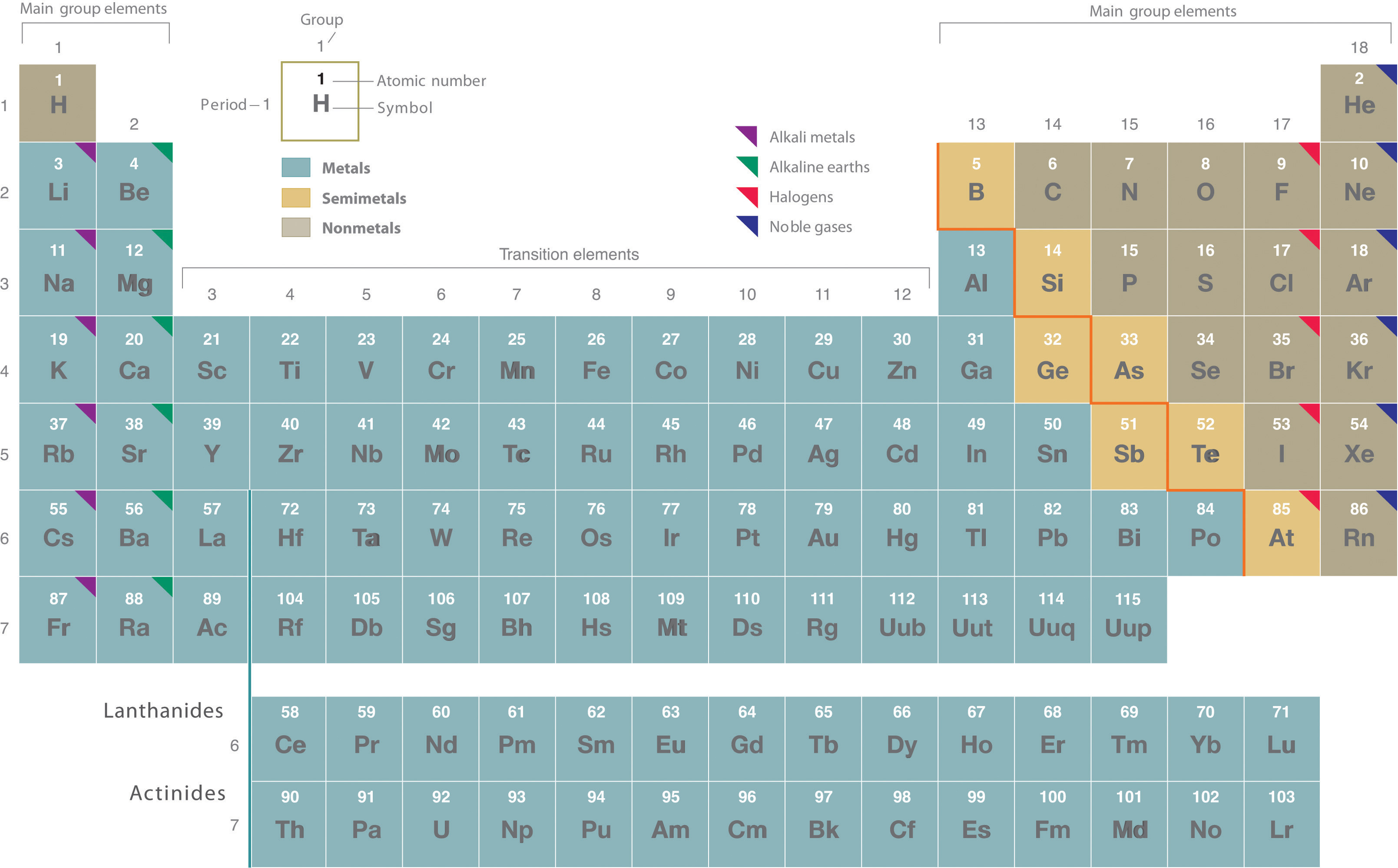
2.5: The Periodic Table - Chemistry LibreTexts
Metals and non-metals in the periodic table - PubMed A link between that theory and the work of Sir Nevill Mott on the metal-non-metal transition is also highlighted. The application of the 'simple', but highly effective Goldhammer-Herzfeld and Mott criteria, reveal when a chemical element of the periodic table will behave as a metal, and when it will behave as a non-metal.

Teach Besides Me: Metals And Nonmetals On Periodic Table
Metals and Nonmetals | Periodic Table - Quizizz What side of the periodic table are metals on? Preview this quiz on Quizizz. QUIZ NEW SUPER DRAFT. Metals and Nonmetals. 0% average accuracy. ... Tags: Topics: Question 3 . SURVEY . Ungraded . 30 seconds . Report an issue . Q. What does ductile mean? ... What side of the periodic table are nonmetals on? answer choices . left. right . top ...

K-12 Periodic Table | Common Sense Education
2.5 The Periodic Table - Chemistry - opentextbc.ca Answer: (a) noble gas; (b) chalcogen; (c) alkaline earth metal; (d) alkali metal. In studying the periodic table, you might have noticed something about the atomic masses of some of the elements. Element 43 (technetium), element 61 (promethium), and most of the elements with atomic number 84 (polonium) and higher have their atomic mass given in ...

Periodic Table Of Elements Metals Nonmetals Metalloids Printable | Awesome Home
The Name-inator: Metals and Non-Metals on the Periodic Table Metals and Non-Metals on the Periodic Table Identifying metals and non-metals on the Periodic Table helps us decide the type of compound and the steps we take to name or write its formula. A few things to note: In general, elements on the left of the Periodic Table are metals. On the right are non-metals. Hydrogen (H) is a non-metal!

Reading the Periodic Table
Metals and Non Metals of the Periodic Table From Group 13 to 16 these are a mixture of metals, non-metals, and semimetals. For example Group 15 contains the non-metals Nitrogen and Phosphorus, the semi-metal Arsenic and the metals Antimony and Bismuth. These non metals have very different properties to metals, they do not tend to barde shiny and wont conduct heat or electricity well.

Teach Besides Me: Is Fluorine A Metal Or Nonmetal
Periodic table labeled with Metals Nonmetals and Metalloids Periodic table labeled with Metalloids Above picture shows you the labeled Metalloids on the Periodic table. They are found between the metals and nonmetals. Elements which have the metallic properties as well as nonmetallic properties are classified as Metalloids. Because of this reason, they are also known as semimetals.
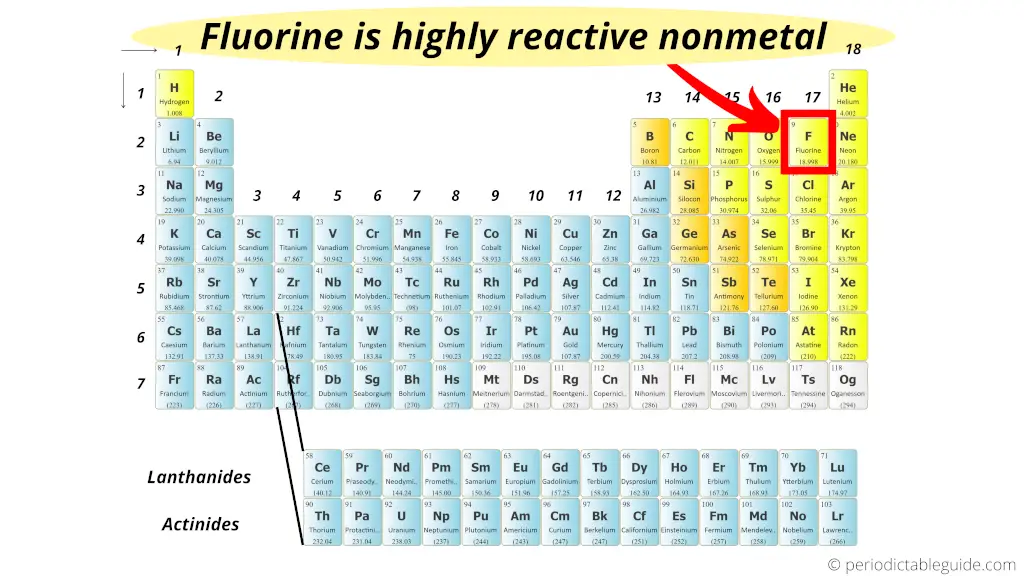
Most Reactive Metal In Periodic Table / Alkall Metals : The periodic table may look complicated ...
PDF Metals Non-Metal Metalloids and the Periodic Table The Metals are represented in the Periodic Table in blue. The Periodic Table H He Li Be B C N O F Ne Na Mg Al Si P S Cl Ar K Ca Sc Ti V Cr Mn Fe Co Ni Cu Zn Ga Ge As Se Br Kr ... The Non-Metals are represented in the Periodic Table in yellow. The Periodic Table H He Li Be B C N O F Ne Na Mg Al Si P S Cl Ar K Ca Sc Ti V Cr Mn Fe Co Ni Cu Zn Ga ...
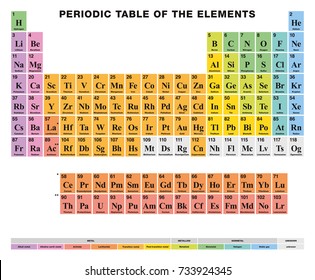
Metalloids Images, Stock Photos & Vectors | Shutterstock
Metals, Nonmetals, and Metalloids on the Periodic Table A description and practice of finding metals, nonmetals, and metalloids on the Periodic Table.In general metals are found on the left-hand side of the period...
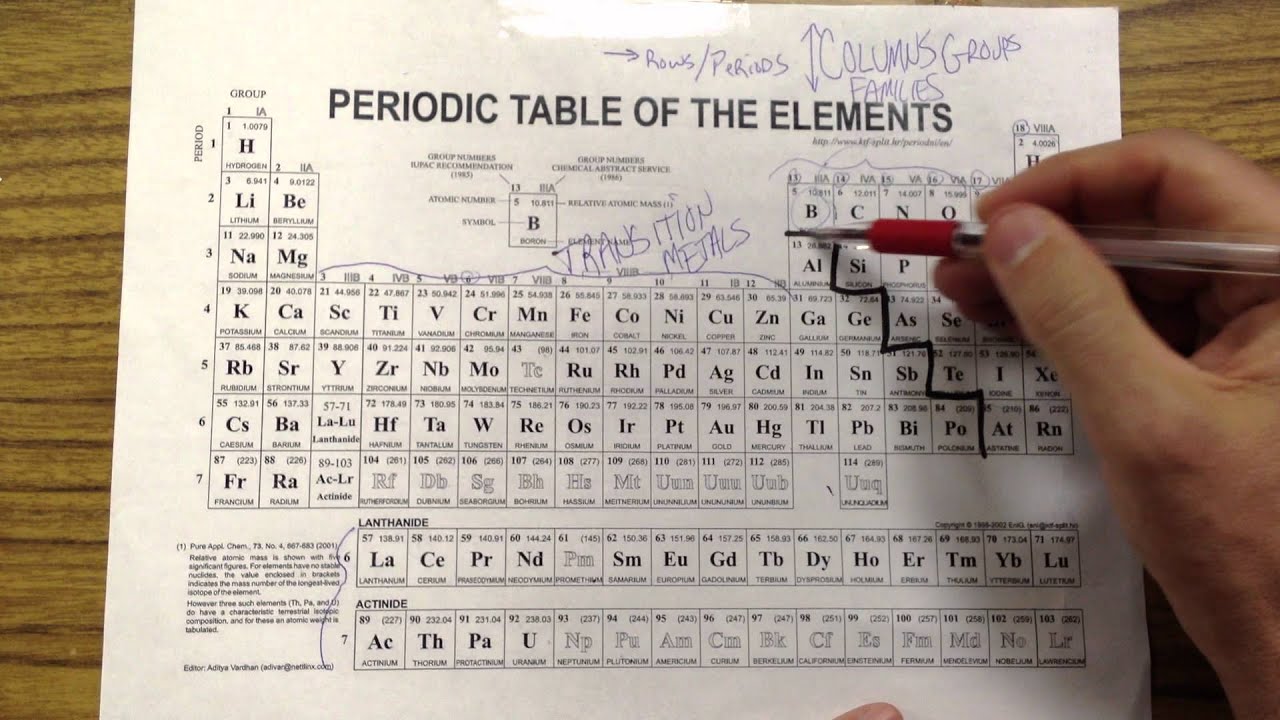
Nonmetals On Periodic Table / Notes Periodic Table Part 2 Sections of the : Hydrogen, helium ...
List of Metals - Science Notes and Projects Location of Metals on the Periodic Table. Over 75% of the elements are metals, so they fill most of the periodic table. Metals are on the left side of the table. The two rows of elements below the main body of the table (the lanthanides and actinides) are metals. Uses of Metals. Metals find use in every aspect of life. Here is a list of some of ...

Freeteacher.co.uk | Chemistry Science Skills
Where are Nonmetals located on the Periodic Table? (+Images) There are 18 nonmetals on the Periodic table. All these nonmetals are located on the upper right corner of the Periodic table ( Hydrogen is located on the left top corner) In the above image, the nonmetals are represented in yellow color. [ Note: Astatine (atomic number 85) shows characteristics of nonmetals (halogens) as well as metalloids.
Post a Comment for "44 periodic table with metal and nonmetal labels"